Most businesses are running their standard playbook, and have no idea what is coming. In this post, I will show you how to leverage AI Agents in 2026 to gain a massive competitive advantage.
A Quick Recap of the Last 4 Years:
- 2022 (The AI Chat Era): We learned to talk to machines with ChatGPT, breaking the technical barrier to intelligence.
- 2023 (The AI Integration Era): The release of GPT-4 allowed AI to connect to our core files, creating specialized context partners.
- 2024 (The AI Picture and Video Era): Sora and Veo collapsed production barriers, letting anyone render film-quality creatives on a budget.
- 2025 (The AI Logic Era): Reasoning arrived, making the AI stop and think to solve PhD-level business and engineering problems safely.
Having watched this evolution from a parlor trick into the absolute backbone of global commerce, the pattern is absolute: we are moving from "typing prompts" to "delegating entire business units." The companies that will dominate the next 36 months aren't just using AI to write emails faster; they are training autonomous AI teams to take over their entire sales, operations, and logistics cycles.
This isn't a speculative trend for 2030; it’s the structure of 2026. This content breaks down how the Autonomous Worker is taking over and maps out exactly where the capital is moving next. Read it, understand the shift, and when you are ready to start building your own autonomous AI workforce instead of watched from the sidelines, let’s get on a call.
2026: The AI Worker Era (AI Agents)
The year of "OpenClaw" and the shift from "Prompts" to "Delegation."
We are here right now. In March 2026, we’ve moved past simple chatbots and into the era of the Autonomous Worker. The most popular tool is OpenClaw, the viral, open-source project that allows anyone to run a personal AI agent on their own machine. OpenClaw has the "keys" to your computer; it can read your files, send your emails, and manage your calendar from WhatsApp or internal hubs.
While OpenClaw is the hackable, community-led leader, enterprise-grade tools like Nvidia’s NemoClaw and the minimalist NanoClaw are providing the security guardrails businesses need. We are building "Shadow Agencies"—teams of these agents that talk to each other using the Model Context Protocol (MCP) to run entire business units while the humans focus on high-level strategy.
The human role has officially shifted from "Doer" to "Architect." We aren't doing the chores; we are setting the Agentic Constitution, the rules and goals our AI workers must follow. In 2026, your competitive advantage isn't how hard you work, but the quality of the "workers" you’ve built to replace your own labor.
💡 The 2026 takeaway: We stop prompting and start delegating.
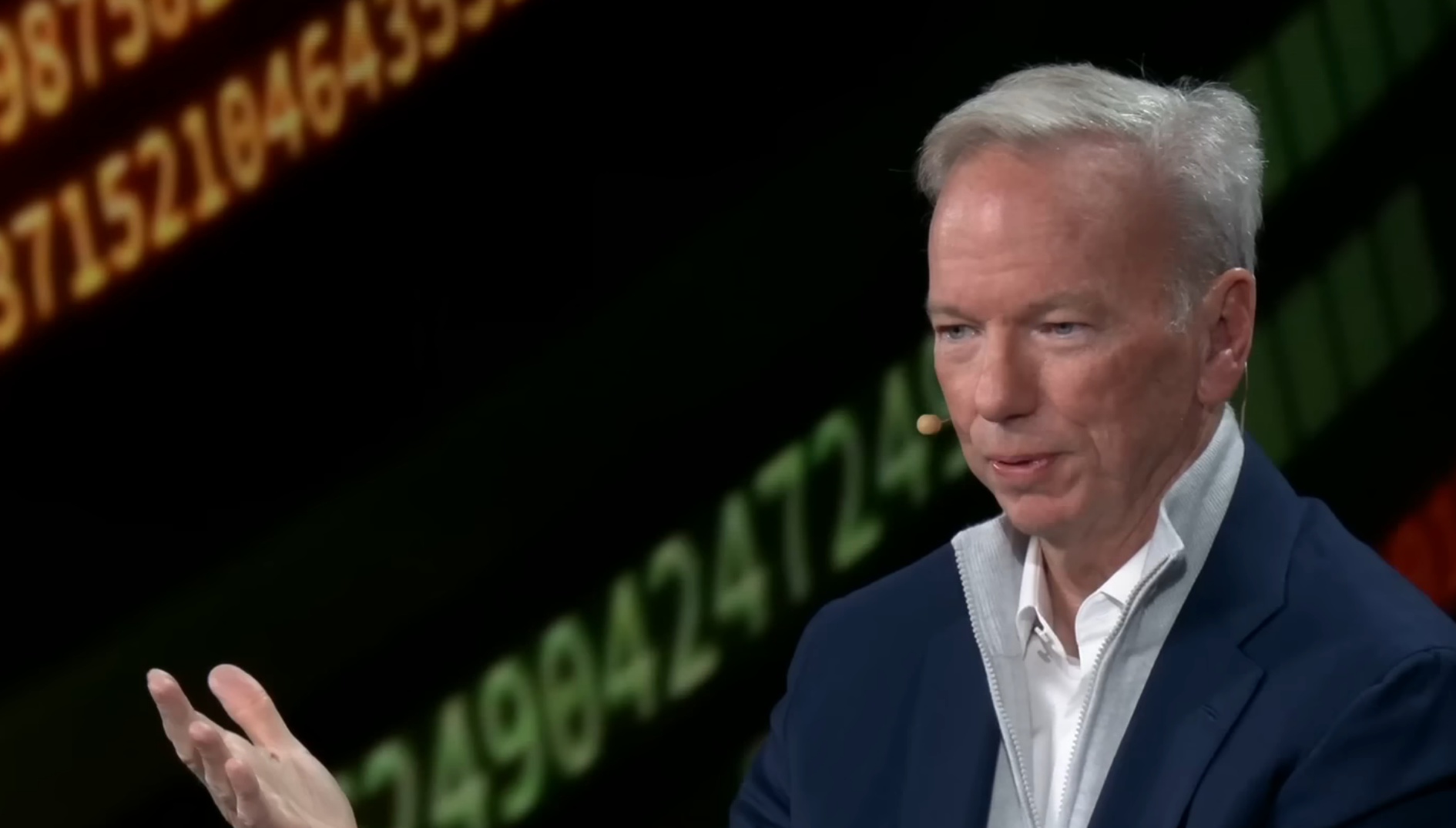
Eric Schmidt: "This is the Year of the Agent"
Who is Eric Schmidt?
Eric Schmidt is the former CEO and Executive Chairman of Google (2001-2011), where he was instrumental in scaling the company into a global technological superpower. He is a prominent investor, philanthropist, and a leading advisor on AI safety and national security infrastructure.
Video Synopsis
In this segment, Schmidt highlights 2026 as the center of the "Agentic Era". He explains that large context windows and recursive reasoning cycles are enabling AI to operate fully autonomously—moving machines beyond chatbot prompts into orchestrating multi-step execution tasks over hours or days securely.
Looking Ahead: The Beyond 2026 Timeline
2027: The AI Buyer Era (AI Commerce)
The year Google’s Universal Commerce Protocol (UCP) turns every brand into a protocol.
By 2027, the way we buy and sell is re-wired by Google’s Universal Commerce Protocol (UCP). This is an open standard that lets AI agents talk directly to a store’s backend to negotiate prices, check real-time inventory, and apply discounts instantly. You don't "browse" a website to buy a laptop; you tell your agent what you need, and it uses UCP to find and buy the best option in milliseconds.
This is the end of traditional "marketing" as we know it. If an AI agent is making the buying decision via UCP, it doesn't care about your flashy banners or your "Add to Cart" button. It cares about clean, machine-readable data. Brands that haven't optimized their data for UCP will find themselves completely invisible to the "Buyer Agents" that now handle 80% of consumer transactions.
We are moving to a Zero-Click economy. Commerce becomes a background process where your agent and the brand's agent negotiate the best deal. To survive, your brand has to be more than a logo, it has to be a "Sovereign Protocol" that any AI can find, verify, and buy from instantly.
In this era, the new currency of commerce isn't dollars or attention, it is data transparency and compute validation. Agents don't bargain with feelings; they offset value based on absolute data endpoints.
💡 The 2027 takeaway: Your brand is a protocol, and your customer is an agent.
2028: The AI Owner Era (100% AI-Run Businesses)
The year of the "Ownerless Company," where the AI runs the entire business lifecycle.
In 2028, we will see the emergence of companies that are fully managed by AI, from the supply chain to the accounting department. These aren't just automated businesses; they are entities that own themselves. The AI handles the sales, pays the bills, manages the production, and optimizes the strategy without a single human employee on the payroll.
These "AI Companies" are terrifyingly efficient because they have zero human overhead and no friction. They can launch a new product, test it in the market, and kill it if it isn't profitable—all in the time it takes a human board of directors to schedule a Zoom call. These entities will often run on decentralized platforms like Ethereum or Solana to ensure their finances are as autonomous as their logic.
The human role in 2028 is that of the Founder of the Protocol. You design the initial mission, set the ethical guardrails, and then step back. You become the beneficiary of the value created by a system that manages itself, allowing you to focus entirely on vision and the next big idea.
💡 The 2028 takeaway: The AI isn't just the worker; it's the boss.
2029: The AI Economy
The year AI manages the "Everything," and humans transition into a life of play.
By 2029, the economy reaches a state of Total Management. AI isn't just running one company; it is managing the entire global supply chain, food production, and energy distribution. Because the AI does a much better job of supplying our basic needs, the "daily grind" is finally broken. We are forced to realize that the economy has changed, and our old definitions of "work" are no longer relevant.
In this world, "Management" is a utility, like oxygen. The economy is a self-optimizing grid that removes waste and friction at a global scale. We move into a "Post-Work" phase where the focus shifts to the things only humans can do—art, philosophy, sport, and deep human connection.
This is the final result of the 7-year jump that started with a simple chat box in 2022. We offloaded the "Managing of Things" to a system that can see every variable at once. In 2029, the goal isn't "productivity"—it's the quality of our Play and the depth of our human experience.
💡 The 2029 takeaway: We stop managing the world and start living in it.